


So what was it like in the Toon in the late 40’s – early 50’s? Well, despite the depredations of the Second World War which had only been over for 5 years or so and the men in the forces demobbed, Tyneside was quite a lively area. Shipbuilding, mining and heavy industry were thriving and the post war building boom was gathering pace. People had a bit of money in their pockets. True the A1 still ran up Northumberland Street, trams were the main public transport and the City’s buildings were black with soot, but Jackie Milburn was soon to lead Newcastle to three FA Cup victories in four years. Memories of the great winter of 1947 when the whole country was paralyzed by snow and ice, were starting to fade and Billy Butlin was about to build his holiday camps where the masses could enjoy fresh air and fun at the seaside. We’d won the war and Atlee’s new Labour government was changing Britain A certain optimism was abroad.


In terms of jazz I guess it all started for me at St Cuthbert’s in the late ‘40’s when with a couple of classmates I became interested in jazz; Clem Avery and Ronnie Robinson were the mates, both of whom later became prominent local jazzmen on trumpet and clarinet respectively. Traditional New Orleans of course. Clem was at the time an unreconstituted Bunk Johnson disciple whilst Ronnie and I had more catholic tastes (it was St Cuthbert’s after all) King Oliver, Louis Armstrong, Jelly Roll Morton and the like. No live jazz for us then but we played our few precious 78s on a wind up gramophone until they were scratched beyond listening.

At the time with my Wallsend mate Gerard I was equally interested in folk music- Ewan McColl and the like. Little did I know then that three quarters of a century later i would hear his wife Peggy Seeger sing live in concert at the Gosforth Civic Hall. Traditional Scottish music was also something of an obsession. One of our other passions was rock climbing which took us into the Cheviots most weekends where we also usually managed to get to the Saturday night dances in Wooler’s Sutherland Hall. This was a former church where the band played up in the choir gallery. As well as local virtuosos like accordionist Johnie Dagg from the College Valley, the dance attracted the top Scottish bands of the day; Bobbie McCloud, Jimmy Shand and our all time favourite Angus Fitchet, ace fiddler from Dundee. Besides the music of course additional attractions were the local innocent beauties who we used to attempt, with minimal success, to charm with all our Wallsend sophistication honed at dances at the old Memorial Hall; “The Mem” which decades later local singer song writer Katie Dougherty immortalised in her song of the same name.
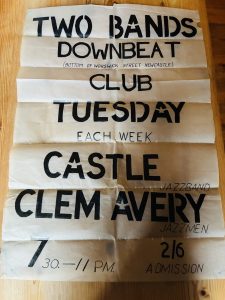
Even so traditional jazz was an equal favourite and live music at the Newcastle Jazz Club a regular treat. Here we could listen to the top local bands; The Panama Jazzmen, Mighty Joe Young and Graham’s dad , trombone player with the Vintage Jazzmen who, twenty years later played at my daughter’s wedding. At that time Jazz was a minority interest. The BBC, the main provider of music, ignored it completely. Youth culture had yet to arrive and pop music was bland, middle of the road stuff for middle aged listeners, so for the jazz fan the local clubs were really important, They were relaxed, friendly, noisy, well lubricated affairs unlike the Newcastle Folk Club where we occasionally went. They we found to be very serious, earnest and obsessive.You weren’t allowed to talk if the singer was on his feet; in fact you weren’t even allowed to enter the hall until the singer finished. Beards.corduroys and tweed jackets with leather patched elbows predominated. Still not as bad as Ewan McColl in Manchester who would only allow singers to sing songs from their native area.

The next big step for me was in 1951 at the age of eighteen I was called up to the army for my two years National Service; the first time I had travelled south of Durham. An otherwise two wasted years was redeemed by friendship with fellow conscript, Londoner John Lilley, a gifted footballer on Tottenham Hotspur’s books , but more importantly a brilliant jazz pianist with a love for and wide knowledge of jazz from its earliest days to the latest cutting edge music. So I became acquainted with the founding fathers, King Oliver, Louis Armstrong’s Hot Five and Hot Seven, Jelly Roll Morton; the Blues singers Leadbelly, Blind Lemon Jefferson, Bessie Smith, Ma Rainey, through the Chicago school of Bix Beiderbeck and Mezz Mezzro, to Duke Ellington and Count Basie, Ella Fitzgerald and Billie Holiday, up to the emerging talents of The Modern Jazz Quartet, Jerry Mulligan and Chet Baker, Dave Brubeck and everything in between. A heady mix for an impressionable young Geordie.
Demobbed in 1953 and back to Tyneside, our meagre record collection expanded but now it was LPs in their glossy sleeves and even an electric record player. But now a new dimension appeared. When funds allowed it was weekend trips to London: cheap, usually overnight trains and questionable B&Bs and prolonged explorations of Soho; music only of course. The highlight was always the visit to the Humphrey Lyttleton Club in Oxford Street where Humph would blow our young minds as well as his trumpet. Mick Mulligan with singer George Melly, party piece Frankie and Johnie, were ever popular.. We also heard the new Chris Barber Band where his young banjo player used to have a spot for a song at the interval. This was the unknown Lonnie Donegan who a few years later had the mega hit with The Rock Island Line which, for better or worse unleashed the whole skiffle epidemic.

One day wandering around Soho, resolutely trying to ignore the porn shops, strip clubs and friendly ladies beckoning to us from doorways,we heard the sounds of New Orleans jazz drifting from a doorway. Like bees to a honey pot we ventured in to find the Chris Barber band in rehearsal. It was just after the split from Ken Colyer`when Pat Halcox had taken over on trumpet and was learning the band arrangements. Chris heard to our pleas to listen in as music starved northerners and kindly allowed us to stay “as long as we didn’t talk”. Whether that was for noise or our accents remains unclear.
After a year or so labouring on the Quayside I started at Newcastle University, or King’s College as it was then.There I had the good fortune to become good friends with Alan Plater; destined later to become a distinguished playwright on stage and television. His “Beiderbecke Affair” starring James Bolam and Barbara Flynn with its Chicago sound track was especially enjoyable for the Jazz fan. A decade or two later The Jumpin’Hot presented Alan at Live Theatre recounting his own jazz story with Kenny Baker and his Dozen providing the musical accompaniment. Alan was obsessed with Duke Ellington and soon enrolled me as a fan whilst in turn I introduced him to the early blues singers including taking him to a memorable Big Bill Broonzy concert at the City Hall.

.
By the end of the 1950’s the embargo organised by the Musicians Union on American artists visiting Britain had been lifted and a new era of live jazz in Britain emerged. In Newcastle the City Hall started an outstanding series of concerts where our heroes, hitherto only heard on record, played live in front of packed houses. So we heard vintage musicians such as Louis Armstrong, Count Basie, Sonnie Terry and Brownie McGhee; our all time favourite Big Bill Broonzie, Ella Fitzgerald with Oscar Peterson plus the moderns like The Modern Jazz Quartet, The Gerry Mulligan Quartet, Dave Brubeck and a host of other stars.
And so life went on as marriage, a growing family and work demands became priorities in the 70’s and 80’s but a new dawn was coming when in 1985 Graham and Adam, a couple of 23 year olds launched the Jumpin’ Hot Club and a cultural ikon was born. It’s first gigs inevitably at the Bridge Hotel although in the refurbished basement instead of the traditional upper room. At first it was local artists; Martin Stephenson, The Hokum Hotshots, Ray Stubbs and his One Man Band.Gypsy Dave etc then national stars like Steve Phillips and Brendan Croker, later to star with Mark Knofler.

Over the next forty years or so the cast of world class musicians became a history of changing tastes in music: Blues with Dr Ross and Guitar Red; Reggae with Prince Buster and Jimmy Cliff; Cajun, D L Mennard and Eddie Lejeune; African, Dembo Konte, Mori Kante and the Bundu Boys; Americana and Bluegrass .Dan Penn and Spooner Oldham, to name but a few. And then there were the legendary festivals: Harambe Africa, Boss Sounds, Evolution and the Country Cantina. All of this endeavour and achievement a testimony to the importance of high quality easily accessible live music at venues ranging from the old Bridge Hotel to the new Sage and Live Theatre.
It was no great surprise when in 2025 Graham and Adam received the North East Culture Award for their Outstanding Contribution to the Cultural Life of the Region.
For this old jazz fan a fitting finale (almost) to forty years of pleasure, education and friendship.
Thanks Graham and Adam.